
- Home
- Hot
- Products
- Application
- About Us
- Technical Guide
- News
- Contact Us
 English
Views: 0 Author: Site Editor Publish Time: 2026-05-04 Origin: Site


In modern animal husbandry, the quality and efficiency of feed preparation have a direct impact on animal health, productivity, and farm profitability. Among the various components that contribute to an efficient feeding system, feed wagon knives play a critical role. These knives are responsible for cutting forage such as hay, silage, straw, and other feed ingredients into uniform sizes, ensuring consistent digestion, reducing waste, and improving overall herd performance.
With advancements in farm machinery and Total Mixed Ration (TMR) feeding systems, precision cutting has become more important than ever. Properly designed feed wagon knives enhance feed homogeneity, reduce labor, and increase operational efficiency.
Feeding livestock is no longer a simple matter of providing raw forage. Modern dairy, beef, and sheep operations rely heavily on uniform feed particle size to ensure proper nutrient absorption. Feed wagon knives are central to achieving this goal.
Uniformly chopped feed promotes better chewing and saliva production, which is essential for maintaining a healthy rumen environment. For instance, cows fed with well-cut silage consume feed more consistently, resulting in increased milk production and healthier digestion. Uneven or oversized particles can lead to selective feeding, where animals eat only preferred ingredients and leave behind fiber-rich components, reducing overall nutritional intake.
TMR systems rely on precise mixing of grains, silage, protein supplements, and minerals. Feed wagon knives help break down large pieces of forage, allowing for a more uniform mixture. This ensures that every bite consumed by the animal contains a balanced portion of nutrients, minimizing selective feeding behavior and improving herd health.
Poorly chopped forage often results in waste. Oversized pieces are harder to chew, leaving more uneaten feed in the trough. Properly functioning feed wagon knives reduce feed waste, which translates into lower operational costs and increased return on investment for farms.
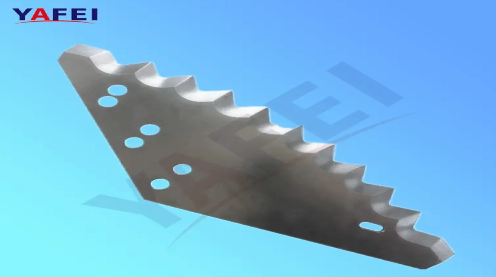
The performance of a feed wagon knife is intricately linked to both its design and the materials used in its construction. In modern animal husbandry, these knives must endure continuous, heavy-duty use, cutting through fibrous, abrasive feed such as silage, hay, straw, and other roughage. A well-designed feed wagon knife not only improves cutting efficiency but also ensures uniform feed particle size, reduces energy consumption, and prolongs the lifespan of the machinery.
Choosing the right material for feed wagon knives is critical for performance, durability, and maintenance. Several materials are commonly used, each offering distinct advantages:
High Carbon Steel – Known for its hardness and affordability, high carbon steel is suitable for basic cutting applications. However, it is prone to corrosion in moist or acidic silage environments, which can shorten the knife's lifespan if not properly maintained.
Alloy Tool Steel (e.g., 65Mn, SK5) – Offers superior wear resistance and toughness, making it ideal for high-intensity cutting of fibrous materials. These steels maintain edge sharpness longer than standard carbon steel and withstand repeated mechanical stress without significant deformation.
Tungsten Carbide-Tipped Blades – Designed for extreme durability, these knives retain sharpness even when cutting dry, coarse, or highly fibrous feed, such as corn stalks or baled hay. They are particularly useful in large-scale operations where downtime for sharpening needs to be minimized.
Boron Steel with Heat Treatment – Boron-infused steel provides an excellent balance between hardness and flexibility. After heat treatment, these knives can withstand high-impact forces without chipping or cracking, making them suitable for heavy-duty mixer wagons handling large volumes of feed.
Selecting the right material is a balance between cost, durability, and the type of feed being processed. For example, dairy farms working with high-moisture silage may prioritize corrosion resistance, while beef feedlots with coarse straw may emphasize hardness and wear resistance.
Beyond the base material, surface treatments play a critical role in extending the knife's operational life and maintaining cutting efficiency:
Heat Treatment and Tempering – Increases hardness and resistance to wear while maintaining sufficient toughness to prevent brittleness.
Hard Chrome Plating or Powder Coating – Provides a corrosion-resistant layer to protect knives from acidic or wet feed conditions.
Laser Hardening – Creates a precisely hardened cutting edge that resists deformation, maintaining sharpness over long periods of use.
Anti-Corrosion Coatings – Designed specifically to combat the effects of acidic silage, moisture, and other environmental factors commonly found in feeding operations.
These treatments ensure that knives remain effective, reducing the frequency of replacements and minimizing downtime for sharpening or maintenance.
Knife geometry significantly affects cutting efficiency, energy consumption, and feed flow. Important design considerations include:
Angle – A sharper cutting angle improves penetration of fibrous material, reducing strain on the mixer’s rotor or auger.
Length and Width – Longer knives cover more feed area per rotation, increasing throughput, while appropriately wide knives maintain stability during cutting.
Curvature – Curved knives are often used in vertical mixers to lift and slice feed efficiently, whereas straight or slightly angled knives optimize feed movement in horizontal mixers.
Edge Design – Serrated edges grip fibrous materials better, reducing slippage and improving cut uniformity, whereas smooth edges reduce drag and are easier to clean.
Proper knife geometry minimizes torque requirements, saving energy and decreasing wear on mechanical components. Optimized designs also improve feed consistency, which is critical for animal nutrition and overall productivity.
Feed wagon knives are versatile and used across a variety of mixer wagon designs, each with specific cutting requirements:
Mixer Type | Knife Design | Function |
Vertical TMR Mixer | Curved serrated knives | Lift and cut forage while mixing to achieve homogeneity |
Horizontal Mixer Wagon | Straight or angled knives | Chop feed into uniform particle sizes for consistent rations |
Self-Propelled Feed Wagons | Heavy-duty replaceable knives | Provide durable, continuous cutting for large-scale operations |
By selecting the appropriate knife for each system, farms can maximize efficiency, reduce energy consumption, and prolong the service life of both knives and mixer machinery.
High-quality feed wagon knives produce uniform particle sizes, which directly benefits rumen function, nutrient absorption, and overall herd health. For dairy cows, consistent feed particle size contributes to stable feed intake and higher milk production, while beef cattle and sheep experience improved digestion and growth rates.
Sharp, well-maintained knives require less power to cut feed, reducing energy consumption in tractor-driven or automated feed wagons. Lower energy use not only reduces operational costs but also places less mechanical stress on the mixer’s motor and drive system.
Dull or poorly designed knives force machinery to work harder, accelerating wear on bearings, shafts, and rotors. High-performance knives maintain cutting efficiency and reduce mechanical strain, extending the lifespan of expensive farm equipment.
By cutting feed precisely and consistently, feed wagon knives minimize leftovers and prevent overloading or under-processing of forage. This reduces feed waste, improves operational cost efficiency, and increases overall return on investment for farms.
Proper maintenance is key to maximizing knife performance and lifespan.
Sharpen knives every 200–400 tons of processed feed depending on the material.
Replace knives when wear exceeds 30% or cracks appear.
Use professional sharpening tools or services to maintain optimal edge geometry.
Install knives at manufacturer-recommended angles.
Tighten bolts evenly to prevent vibration or misalignment.
Check rotor clearance to avoid blade friction and unnecessary wear.
Remove silage residues, moisture, and debris after use.
Apply anti-rust coatings for long-term storage.
Store spare knives in dry, ventilated conditions to prevent corrosion.
Regular inspection and monitoring of knife performance, such as checking for uneven wear or bending, ensures consistent cutting and reduces the risk of downtime.
Silage acidity causing blade corrosion
Hard foreign objects (stones, nails) damaging knives
Uneven wear in multi-knife systems
High labor and maintenance costs in large-scale operations
Self-sharpening serrated knives for longer service intervals
Replaceable carbide inserts for heavy-duty applications
Laser-hardened edges for precision cutting
Sensor-based monitoring of blade wear and vibration for predictive maintenance
These innovations enhance operational efficiency and reduce maintenance time, enabling farms to achieve better feed consistency and productivity.
Feed wagon knives are small components with a significant impact on modern animal husbandry. Precision cutting enhances feed mixing, improves digestibility, reduces waste, and protects both machinery and herd health. Selecting the right material, design, and maintenance strategy ensures that feed wagon knives deliver consistent performance for years.
For livestock producers seeking reliable, durable, and precision-engineered feed wagon knives, ANHUI YAFEI MACHINE TOOL CO., LTD provideshigh-quality solutions, technical support, and custom options tailored for modern feeding systems. Partnering with experienced manufacturers helps farms optimize feed efficiency, improve animal health, and maximize operational profitability.


