
- Home
- Hot
- Products
- Application
- About Us
- Technical Guide
- News
- Contact Us
 English
Views: 0 Author: Site Editor Publish Time: 2026-08-02 Origin: Site


Slitting silicon steel presents high-stakes challenges for manufacturers today. The abrasive silicon content rapidly wears down standard tooling edges. Downstream applications demand extremely strict burr height tolerances. You simply leave zero room for edge degradation. A generic tooling setup will not suffice for these demanding runs. Choosing the proper blade requires balancing material hardness with fracture toughness. Failing to achieve this balance results in highly costly line stoppages. This article provides a clear, engineering-focused framework for your operations. We will explore how to evaluate, select, and implement a rotary slitting knife designed specifically for silicon steel applications. You will discover the exact substrates needed for aggressive materials. We will cover the geometry required to stop blade wander. You will also learn practical setup techniques to ensure pristine cuts.
Material dictates uptime: Tungsten carbide offers up to 10x the run time of conventional tool steel but requires high machine rigidity to prevent chipping.
Geometry prevents deflection: Sub-micron thickness tolerances and optimal surface finishes are mandatory to minimize knife deflection and maintain tight clearances.
TCO over unit price: Evaluating blades based on cost-per-cut and regrinding lifespan is a more reliable metric than upfront tooling costs.
Processing electrical grades of steel introduces unique metallurgical hurdles. Silicon is alloyed into the steel to increase electrical resistivity. This process minimizes energy loss in magnetic applications. However, this same silicon creates a highly abrasive material structure. It acts like microscopic sandpaper rubbing directly against your tooling. Processing this steel rapidly dulls conventional cutting edges.
Brittleness further complicates the shearing process. Silicon steel resists clean shearing forces. It often produces micro-fractures along the slit edge if the setup is incorrect.
Edge burrs and camber severely impact final magnetic properties. In transformer core cutting, manufacturers assemble thousands of individual steel laminations. A burr height exceeding acceptable limits creates microscopic air gaps between these layers. These gaps reduce stacking efficiency drastically. They also increase core loss and degrade the overall transformer performance. We must maintain pristine, burr-free edges to ensure optimal magnetic flux.
Standard tooling reaches its limit very quickly here. A generic metal slitting knife simply fails under continuous high-speed processing. High-speed lines processing electrical steel destroy standard tool steel edges in a fraction of the expected time. This rapid edge degradation leads directly to unacceptable burr heights. You experience frequent line stops for premature blade changes. This limits your overall production capacity.
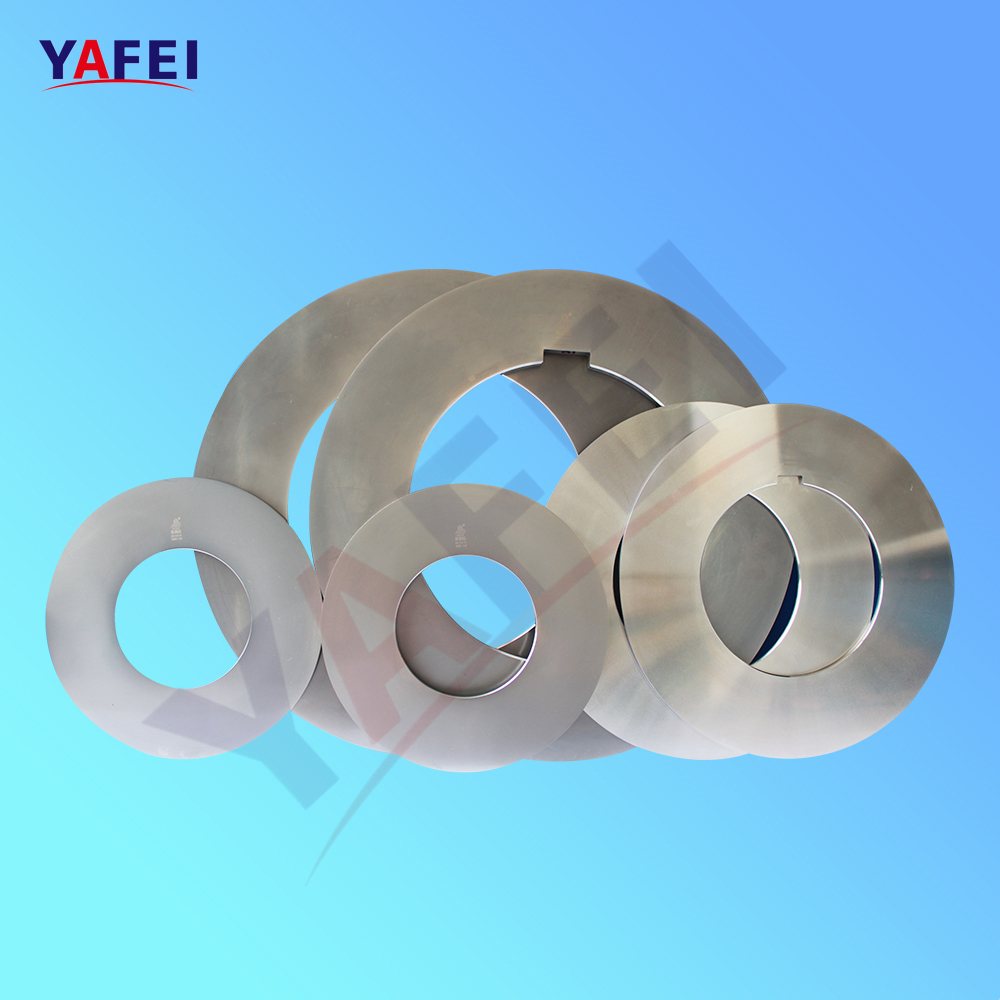
Selecting the correct substrate determines your slitting line's reliability. We evaluate two main material categories for these aggressive environments.
A tungsten carbide slitting knife offers exceptional wear resistance. It maintains a razor-sharp edge significantly longer than any steel alternative. You will see optimal results on high-volume, continuous processing lines. The dense matrix of carbide particles withstands the abrasive nature of silicon brilliantly.
However, carbide brings specific risks and realities. It remains a highly brittle material. The blades are highly susceptible to micro-chipping. Arbor setups lacking extreme rigidity will destroy these blades. Deflection in the arbor shaft translates directly into lateral shock on the blade edge. Operators must handle them flawlessly during tooling changeovers to prevent impact damage. Dropping a carbide blade even an inch onto a hard surface can ruin it.
Advanced Powdered Metallurgy (PM) tool steels provide a different balance of properties. They offer higher toughness than carbide. They resist shock and vibration highly effectively. The uniform grain structure of PM steel eliminates weak points found in conventionally forged steels.
You must accept certain trade-offs with PM steel. It requires more frequent regrinding compared to carbide. However, general handling risks remain much lower. PM steel is an excellent choice for older slitting lines. It withstands minor arbor deflections without catastrophic chipping.
How do you choose between these materials? Your choice depends on several engineering variables. Line speed, material gauge, and machine condition dictate your path. Older, vibration-prone slitters should avoid carbide entirely.
Material Substrate Comparison for Silicon Steel Slitting | ||||
Substrate Type | Wear Resistance | Fracture Toughness | Ideal Machine Condition | Operational Risk Profile |
|---|---|---|---|---|
Tungsten Carbide (Sub-micron) | Exceptional | Low (Highly Brittle) | High rigidity, modern arbors | Requires expert handling |
Powdered Metallurgy (PM) Steel | Good | High | Vibration-prone or older setups | Standard operational handling |
Standard D2 Tool Steel | Poor for Silicon | Moderate | Not recommended for silicon steel | Frequent line stops required |
Material hardness alone cannot guarantee a clean cut. The precise geometry of a silicon steel slitting blade plays an equally critical role. Sub-micron precision keeps the slitting process stable and repeatable.
Thickness and flatness tolerances remain non-negotiable. Often, these tolerances require ±0.001 mm accuracy. These tight specifications maintain a consistent horizontal clearance across the entire arbor. If blades lack perfect flatness, they wobble during rotation. Inconsistent clearances cause the blade to wander. This wandering ruins the slit edge and severely damages the knife itself.
Managing knife deflection requires addressing the physics of slitting. Heavy lateral forces occur during the shearing process. Proper blade profiles and rigid spacer rings prevent the knife from deflecting under these side loads. We aim for a clean shear rather than a messy tear. Deflection alters the entry angle of the blade. This introduces severe mechanical stress on the cutting edge.
We must observe the following geometry standards to minimize deflection:
Parallelism: Faces must remain perfectly parallel to distribute arbor nut torque evenly across the tooling stack.
Concentricity: The inner bore and outer diameter must align precisely to prevent radial runout during high-speed rotation.
Edge Bevel Profile: The cutting angle must match the specific gauge of the silicon steel perfectly to reduce shear stress.
Surface finish requirements also heavily influence friction and heat generation. A highly polished, lapped finish reduces lateral friction significantly. It minimizes heat buildup during high-speed production runs. A smooth finish prevents material pickup. Solder or micro-welding on the blade face degrades cut quality instantly. Polished blades shed metallic dust and maintain cooler operating temperatures.
Even the highest quality rotary slitter blade will fail if implemented poorly. Precise setup dictates your final cut quality and overall tooling lifespan.
Horizontal and vertical clearance calculations demand strict adherence to material gauge. Silicon steel requires very tight horizontal clearances to shear correctly. If the clearance is too wide, the material bends before tearing. This creates massive, unacceptable burrs. If the clearance is set too tight, the opposing blades clash. Clashing instantly chips the brittle cutting edge. You must utilize highly accurate shimless tooling or precision ground shims to dial in these clearances.
Upgrading to premium blades requires a distinct operational shift. You cannot treat carbide like standard tool steel. Handling and regrinding constraints require careful planning. Tungsten carbide demands specialized diamond wheel regrinding facilities. Standard grinding wheels will cause heat checks and micro-cracks in the carbide matrix. You must verify your regrinding partner has specific expertise handling highly brittle substrates.
Operator training represents a critical, often hidden, success factor. Operators must adopt strict new protocols to prevent premature blade failure. Consider these mandatory training requirements for your team:
Clean all spacer rings and arbor shafts meticulously before assembly to prevent lateral runout.
Use calibrated torque wrenches to secure arbor nuts evenly, preventing localized stress on the tooling face.
Never rest carbide blades directly on steel benches; always use rubber, plastic, or wooden mounting mats.
Use specialized mechanical lifting tools to mount large diameter blades without striking the steel arbor threads.
Inspect the stripper rings for uneven wear, as inconsistent stripping forces cause severe blade deflection.
Sourcing specialized tooling requires evaluating the manufacturer's deep technical capabilities. A reliable tooling partner controls the entire engineering and production process.
You must insist on strict metallurgical traceability. Request certified material test reports (MTRs) for every batch of blades. These documents verify the exact grade and origin of the carbide or PM steel used. Counterfeit or lower-grade materials will fail unpredictably under heavy slitting loads.
Favor suppliers maintaining in-house machining and grinding operations. Controlling heat treatment, precision grinding, and surface lapping processes internally guarantees product consistency. Outsourced processing introduces uncontrolled variables. Those variables often manifest as dimensional inaccuracies or internal material stresses. These flaws lead directly to premature edge failure.
Seek out consultative engineering. A reliable partner asks detailed technical questions before quoting a blade. They will inquire about your exact arbor diameter, maximum line speed, specific material gauge, and required burr tolerances. Complex silicon steel applications resist "off-the-shelf" promises. Your supplier should engineer a custom solution matching your exact mechanical constraints. They should analyze your current wear patterns to recommend the perfect edge geometry.
Choosing the correct tooling for silicon steel requires a calculated balance. You must carefully weigh material hardness against your machine's operational rigidity. Tungsten carbide delivers exceptional wear resistance for highly rigid, modern slitting lines. Advanced PM steels offer the necessary toughness for older, vibration-prone equipment. Sub-micron geometry and perfect surface finishes prevent deflection and heat buildup.
We encourage you to audit your current blade lifespan immediately. Calculate your precise downtime expenses related to frequent blade changeovers. Request a technical consultation from a specialized industrial blade manufacturer. Initiate a small sample testing program to validate clearance calculations and material compatibility directly on your own equipment. Taking these proactive steps ensures uninterrupted production and pristine slit edges.
A: The maximum allowable burr height is typically kept under 0.02mm. This limit depends heavily on the specific core design and insulation requirements. Sharp blades directly control this metric. A dull edge drags material downward before shearing, pulling an excessive burr that ruins stacking efficiency.
A: You can usually regrind a tungsten carbide knife 10 to 15 times. This depends on wear depth and the original outer diameter tolerances allowed by your machine. Deep chipping reduces this number drastically. Remember, specialized diamond grinding is required to prevent micro-cracking during the sharpening process.
A: Chipping generally stems from three root causes. First, improper clearance settings cause blade clashing. Second, bearing wear introduces arbor vibration, shocking the brittle edge. Third, using a carbide blade on an older setup with insufficient rigidity leads to catastrophic edge failure. Always match blade material to machine condition.


