
- Home
- Hot
- Products
- Application
- About Us
- Technical Guide
- News
- Contact Us
 English
Views: 0 Author: Site Editor Publish Time: 2026-09-17 Origin: Site


A suboptimal cup and tray sealing blade doesn't just result in a poor cut; it causes micro-leaks, packaging jams, and costly unplanned machine downtime. In high-speed food packaging environments, this cutting component represents the absolute final point of failure before a product reaches the consumer. If this component fails, your entire production batch suffers immediately. Selecting the ideal replacement part requires carefully balancing raw material durability against film-specific tooth profiles. You must concurrently guarantee stringent food-safety compliance to protect your brand reputation. This guide provides a detailed technical and operational framework for evaluating, shortlisting, and selecting the right sealing blades for your specific production line. You will learn how advanced friction-reducing coatings prevent melted adhesive buildup during intense thermal cycles. Furthermore, we will explore exactly how customized edge geometries safeguard your seal integrity while simultaneously increasing your maximum cycle speeds.
Blade material and coating must be matched to the specific packaging film (e.g., PP, PET, Aluminum foil) to prevent adhesive buildup and tearing.
Tooth geometry (pitch, depth, and profile) directly dictates seal integrity and cycle speed.
Evaluating Total Cost of Ownership (TCO)—factoring in wear life and changeover frequency—is more reliable than comparing upfront unit costs.
Precision tolerances are critical for seamless integration with an auto packaging machine to avoid alignment-induced wear.
Many operators mistakenly view a packaging sealing blade as a basic consumable item. This mindset creates hidden operational risks across your entire facility. You should instead treat these cutting tools as critical production assets. Shifting this perspective allows you to optimize your production lines effectively.
An incorrect profile choice leads to immediate and severe line issues. Ragged film edges directly compromise modified atmosphere packaging (MAP). Micro-leaks allow oxygen ingress, which rapidly accelerates food spoilage. You will likely encounter melted plastic buildup on the cutting edge if you use an improper material. This accumulated plastic causes severe thermal inconsistencies during the sealing process. Thermal imbalances prevent the film from bonding securely to the tray lip.
A successful implementation transforms your daily operations. You achieve perfectly clean cuts while running equipment at maximum cycle speeds. You significantly extend the mean time between maintenance interventions. Most importantly, you completely eliminate product recalls caused by seal failures.
Log the exact cycle count at which cut quality begins degrading.
Train operators to spot micro-tears in the film before full seal failure occurs.
Standardize your blade replacement protocols based on material wear data rather than calendar days.
Ignoring early warning signs like stringy film edges or excessive machine noise.
Using a universal blade profile for dramatically different lidding films.
Failing to calibrate sealing head pressure after installing a new cutting tool.
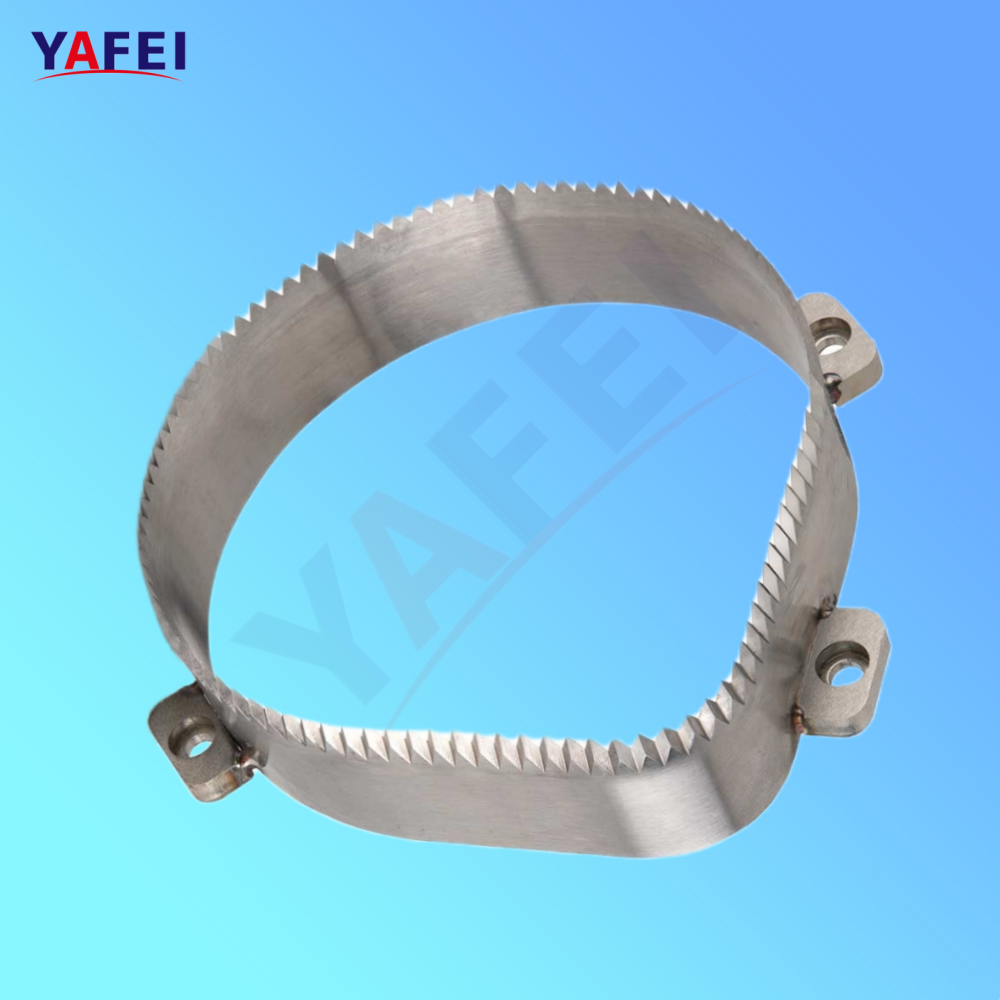
Selecting the perfect tray sealer blade requires analyzing three distinct variables. You must carefully weigh material durability, optimize the tooth geometry, and apply the correct surface treatment.
Your base material dictates how well the edge survives mechanical stress and chemical exposure. Many facilities rely heavily on 400-series stainless steel. It offers excellent corrosion resistance for intense washdown environments. However, stainless steel loses its sharp edge faster than harder industrial alloys.
High-speed steel (HSS) holds a sharp edge significantly longer under continuous friction. Yet, HSS rusts quickly when exposed to harsh chemical cleaning agents. Carbide provides extreme hardness and unmatched longevity. You should reserve carbide components for cutting highly abrasive lidding films or extended high-volume runs.
Table 1: Material Comparison for Sealing Blades | |||
Material Type | Edge Retention | Corrosion Resistance | Ideal Application Scenario |
|---|---|---|---|
400-Series Stainless Steel | Moderate | Excellent | Standard food packaging with frequent chemical washdowns. |
High-Speed Steel (HSS) | High | Low | Dry packaging environments requiring long production runs. |
Solid Carbide | Extreme | High | Highly abrasive films where maximum cycle life is demanded. |
Tooth geometry dictates exactly how the metal pierces the polymer film. You must match the tooth profile to the specific density and elasticity of your lidding material. Pitched teeth work beautifully for thick, rigid polymers. Scalloped edges slice smoothly through brittle aluminum foils without crushing the material. Straight edges suit simple push-through applications where tearing is unlikely.
A specialized cup sealing knife often requires a custom-formed profile. Highly elastic films stretch before they tear. A custom-formed tooth profile initiates the cut seamlessly, preventing the film from bunching up around the sealing head.
High-temperature sealing cycles melt plastics instantly. Melted adhesive naturally accumulates on bare metal surfaces. Friction-reducing coatings eliminate this sticky buildup completely. They prevent plastic from melting onto the cutting edge during high-temperature operations.
PTFE (Teflon): Provides a superb non-stick barrier for low-temperature sealing applications.
Titanium Nitride (TiN): Hardens the surface significantly and reduces drag during high-speed piercing.
Ceramic Coatings: Withstand intense thermal cycles without degrading, making them ideal for heavy-duty sealing.
Precision matters deeply when integrating new cutting tools into your packaging equipment. You face an important choice between original equipment manufacturer (OEM) parts and aftermarket alternatives.
OEM replacements guarantee an exact fit right out of the box. However, relying solely on them restricts your engineering flexibility. High-precision aftermarket parts often provide superior performance customized to your exact film type. You must enforce strict qualification processes when adopting these alternatives. Request detailed technical drawings and conduct small-batch testing before committing to a full deployment.
Micro-tolerances remain critical for formed profiles. An inaccurate auto packaging machine blade causes uneven pressure distribution across the entire sealing head. Uneven pressure wears down the equipment prematurely. Alignment-induced wear forces your operators to halt production frequently for manual adjustments. Even a fraction of a millimeter in dimensional variance can destroy the seal integrity on a high-speed line.
You must verify all mounting configurations meticulously. Review the specific bolt-hole patterns before finalizing any order. Check the slot dimensions against your equipment manual to ensure seamless integration.
Consider adopting rapid-changeover designs. They help your maintenance team tremendously. Operators can swap components quickly and restore production immediately. Follow these integration steps:
Isolate the machine and lock out all power sources.
Remove the worn blade and inspect the anvil for residual adhesive buildup.
Clean the mounting bracket using approved non-abrasive solvents.
Align the new blade precisely using the manufacturer's guiding pins.
Torque all mounting bolts to the exact specifications listed in your machine manual.
Food safety regulations heavily dictate your tool selection process. Your facility cannot afford a contamination event stemming from inappropriate machinery components.
Your chosen food packaging knife must comply with stringent regulatory standards. You need verifiable adherence to FDA, CE, or local food contact directives. Material safety data sheets (MSDS) should accompany every shipment. These documents prove the chosen steel alloy contains no toxic heavy metals that could leach into the product.
Sanitary risks hide in poorly manufactured components. Roughly machined edges create microscopic bacterial traps. These tiny grooves harbor organic matter that survives routine cleaning. Flaking surface coatings present another massive hazard. If a brittle coating chips off during a sealing cycle, it directly contaminates the consumer product. You must prioritize hygienic design above all else by selecting blades with ultra-smooth surface finishes.
Washdown resilience presents a major daily hurdle. Food packaging facilities use harsh alkaline cleaners and high-pressure hot water. Your chosen steel alloy must survive these chemical attacks without oxidizing. The applied surface coating must remain fully intact under high-pressure sprays. Implementing a strict visual inspection routine after every washdown ensures the coating remains uncompromised.
Evaluating potential suppliers requires looking far beyond initial acquisition metrics. You must build a comprehensive framework that measures true operational efficiency over the tool's entire lifespan.
You should evaluate the "cost per thousand cuts" efficiency metric. This framework highlights long-term performance over simple upfront figures. A durable edge reduces your replacement frequency drastically. When you measure performance by yield rather than initial outlay, high-quality alloys immediately prove their value.
Extended longevity minimizes your machine downtime exponentially. Consider a profile lasting 20% longer than your current standard. This improvement significantly reduces the labor hours spent on manual changeovers. You reclaim lost production time instantly. Fewer machine stops also mean fewer rejected packages during the machine restart phase.
Chart 1: Reactive Replacement vs. Proactive Optimization Strategy | |||
Strategy Type | Maintenance Approach | Production Uptime | Overall Equipment Effectiveness (OEE) |
|---|---|---|---|
Reactive Strategy | Run to failure; replace only when seal quality degrades visibly. | Low (Frequent unplanned stops) | Decreased due to high rejection rates. |
Proactive Strategy | Scheduled replacements based on calculated cycle limits. | High (Predictable maintenance windows) | Maximized due to consistent seal integrity. |
Selecting the right manufacturing partner ensures consistent quality. Use this vetting checklist when evaluating potential suppliers:
Do they offer custom engineering based on your specific film samples?
What are their standard lead times for replacement batches?
Can they accommodate rapid prototyping for new packaging lines?
Do they provide comprehensive material certification reports?
Do they supply full traceability documentation for your safety audits?
A capable supplier acts as an engineering partner. They analyze your torn film samples and recommend specific tooth geometries to resolve your exact cutting failures.
Selecting the right cutting component requires a holistic evaluation of your entire operation. You must carefully analyze your lidding film type, specific machine specifications, and the harshness of your washdown environment. Upgrading your components eliminates micro-leaks, prevents thermal inconsistencies, and drastically improves your operational uptime. Treat these tools as critical assets rather than basic consumables.
For your immediate next steps, conduct a thorough audit of your current blade wear patterns. Log the exact cycle counts where degradation begins. Next, send a technical drawing or a physical film sample to a trusted manufacturer for a profile match. Finally, order a small trial batch of custom-coated blades to test their longevity against your existing production metrics.
A: You should base replacement schedules on operational variables rather than a fixed calendar timeframe. Monitor your equipment's cycle rate, the specific film thickness, and the lidding material hardness. Establish a baseline cycle count where cut quality begins degrading, and schedule preventive replacements just before reaching that specific threshold.
A: You should generally replace them. While resharpening appears resource-efficient, it alters the blade's precise dimensions. Altered dimensions directly impact the pressure distribution across the sealing head. This uneven pressure causes incomplete seals. Replacing the component guarantees dimensional accuracy and maintains consistent packaging integrity.
A: Plastic sticks due to operating temperature mismatches and bare metal surfaces. High-speed sealing generates intense heat, melting the polymer film and its adhesive layer. If your cutting tool lacks a friction-reducing non-stick coating like PTFE or TiN, the melted plastic accumulates rapidly on the bare metal.
A: Yes, changing films often dictates a geometry change. Transitioning from a brittle aluminum foil to a highly elastic polymer completely alters the cutting dynamics. Elastic films stretch before breaking, which requires a specialized pitched or formed tooth profile to pierce the material cleanly and prevent tearing.


