
- Home
- Hot
- Products
- Application
- About Us
- Technical Guide
- News
- Contact Us
 English
Views: 0 Author: Site Editor Publish Time: 2026-07-09 Origin: Site


In high-volume paper manufacturing and converting, cutting efficiency directly dictates production throughput. Micro-imperfections in blade geometry or premature edge wear lead to compounding financial losses through machine downtime and compromised product quality. Plant managers and procurement teams must balance the upfront capital expenditure of premium tooling against the operational realities of blade degradation, sharpening frequency, and paper dusting. Selecting the wrong blade material or profile for a specific paper grade accelerates wear and increases long-term operational expenses. This guide provides a technical evaluation of the primary Knives For Paper Industry applications, comparing blade architectures, metallurgical compositions, and operational frameworks to optimize procurement and maintenance strategies.
Application Dictates Architecture: Guillotine, rotary, and trimmer knives serve distinct operational phases; selecting the correct profile is non-negotiable for dimensional accuracy.
Material Trade-Offs Drive ROI: While Tungsten Carbide requires a higher initial investment (often 3-4x that of High-Speed Steel), its superior wear resistance typically yields lower long-term costs in continuous, high-volume mill environments.
Paper Composition Impacts Wear: Recycled fibers, heavy coatings, and abrasive fillers degrade standard steel rapidly, necessitating advanced alloys or carbide inlays to maintain edge integrity.
Maintenance is a Hidden Cost: Improper handling, misaligned installation, and reactive (rather than predictive) sharpening schedules negate the value of high-end industrial knives.
Achieving optimal performance in a paper mill requires strict adherence to operational metrics. Establishing clear success criteria ensures your cutting operations remain profitable and efficient. You cannot manage what you do not measure on the mill floor. Operators must track specific variables to determine if a blade performs to its engineered specifications.
Cut quality serves as the primary indicator of blade health. You must establish baseline metrics for clean edges and dimensional tolerance. The complete absence of fiber pull or chipping is mandatory for high-grade paper products. Edge retention measures how long a blade maintains this pristine cut. Materials with higher wear resistance hold their bevel angles longer. This consistency prevents the gradual degradation of sheet edges during long production runs. When edge retention drops, operators notice immediate fuzziness on the paper stack edges. This requires immediate intervention to prevent entire pallets from being rejected by quality control.
Defect Type | Visual Indicator | Root Cause | Corrective Action |
|---|---|---|---|
Fiber Pull | Fuzzy or frayed sheet edges | Dull cutting edge or incorrect bevel angle | Replace blade; verify bevel matches paper grade |
Chipping | Uneven, jagged cuts on the stack | Hard contaminants in paper or brittle blade | Inspect paper source; switch to tougher alloy |
Welding | Melted coating on the cut edge | Excessive friction from dull blade | Increase sharpening frequency; check blade clearance |
Machine downtime severely impacts mill profitability. You must calculate the financial impact of every blade changeover. Stopping a high-speed sheeter to replace a dull knife halts the entire production line. Evaluating how extended edge life translates to increased operational uptime is necessary for accurate procurement. Investing in harder alloys often reduces the frequency of these interruptions. Fewer changeovers mean higher daily throughput and better resource allocation. A standard blade change on a primary sheeter can take up to two hours when factoring in calibration and test runs. Multiplying that lost production time across a fiscal year reveals the true expense of inferior tooling.
Paper dust creates significant operational hazards. We must analyze the relationship between blade sharpness, bevel angle, and dust generation. Dull blades crush fibers instead of shearing them cleanly. This crushing action releases massive amounts of particulate matter. Paper dust fouls sensitive machinery components and degrades print quality. Maintaining precise, sharp edges is the most effective method for dust reduction. High dust levels also pose severe fire risks in the mill environment. Vacuum systems can only handle a specific volume of particulate before becoming overwhelmed. The primary defense against dust is a perfectly honed cutting edge.
Mill-level cuts must meet strict downstream requirements. Commercial printing and bookbinding machinery operate at extreme speeds. Sheets must feed perfectly to prevent jams and misregisters. Edge-binding issues often stem from microscopic imperfections in the initial mill cut. Ensuring clean, precise cuts at the mill prevents feeding failures for your customers. Quality control here protects your reputation in the broader market. A printer running a high-speed offset press will immediately notice if the paper edges are not perfectly square. This leads to rejected shipments and damaged client relationships.
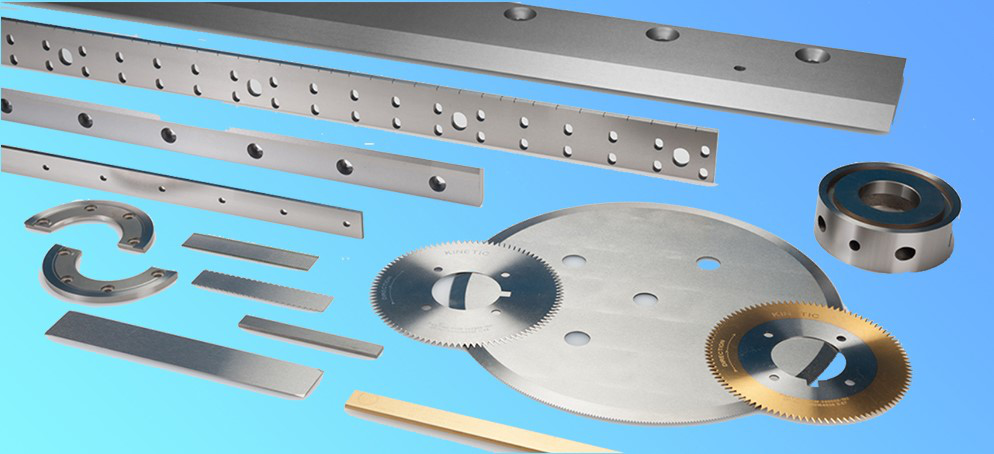
Different stages of paper production require specific blade architectures. Using the wrong knife profile guarantees poor results and rapid tool failure. Each machine on the floor demands a specific geometry to handle the unique stresses of its operation.
Guillotine knives handle the heavy lifting in sheet production. They are used for cross-cutting large webs into individual sheets and bulk stack cutting. These blades require immense structural rigidity. They must prevent deflection under massive hydraulic pressure during the cutting stroke. A deflected blade causes uneven cuts through the paper stack. Engineers design these knives with robust backing materials to withstand constant mechanical shock. The bevel angle on a guillotine knife is highly dependent on the paper density. Softer papers require a more acute angle, while dense, recycled boards need a blunt, robust edge to prevent chipping.
Rotary knives operate in continuous roll cutting applications. They slit wide paper webs into narrower rolls using top and bottom slitter configurations. This application demands precise concentricity. Strict tolerances are required to maintain a continuous shear cut without causing web breaks. Even minor runout in a rotary blade causes uneven wear and poor slit quality. Operators must ensure perfect synchronization between the upper and lower blades. The overlap and side load pressure between the top and bottom slitters must be calibrated daily. Too much pressure generates excessive heat and premature wear, while too little pressure causes the web to tear rather than cut.
Inspect the top slitter for any micro-fractures along the cutting edge.
Verify the bottom slitter band is perfectly seated on the drive shaft.
Set the side load pressure according to the specific paper caliper.
Adjust the overlap depth to ensure a clean shear without excessive friction.
Run a test web at low speed to check for edge fraying or dust generation.
Trimmer knives are deployed primarily in finishing operations. Bookbinding and printing facilities use them to trim multiple sides of a bound product simultaneously. The focus here is on extreme fine precision. A clean cut prevents spine tearing and ensures uniform final dimensions for books and magazines. These knives often feature specialized bevels to handle dense, glued paper stacks without tearing the cover material. The clamping pressure applied before the cut is just as important as the blade itself. If the clamp does not hold the book block securely, the trimmer knife will pull the pages, resulting in a stepped, uneven edge.
Core cutting knives serve a very specialized function. They cut the thick cardboard tubes used for winding finished paper rolls. Core materials are highly abrasive and dense. They contain heavy glues and recycled materials that dull standard blades instantly. Core cutting knives must withstand this severe abrasion. Manufacturers often use specialized tooth profiles or extreme-wear materials for these applications. The dust generated by cutting cores is highly abrasive. It can quickly wear down the machine guides and bearings if the blade is not cutting cleanly.
Manual safety and utility blades remain essential on the mill floor. Operators utilize slab-off knives for roll stripping. They safely remove damaged outer layers from large paper rolls. Utility knives assist in sample preparation and general maintenance. Evaluation of these tools prioritizes operator safety. Ergonomic handles and auto-retracting mechanisms are standard requirements. Quick-change blade systems prevent bottlenecking during critical roll-prep phases. A dull slab-off knife forces the operator to use excessive physical force. This increases the risk of slipping and causing severe workplace injuries.
Metallurgy dictates blade performance. Selecting the right material involves balancing initial investment against expected wear rates and paper abrasiveness. You must match the steel grade to the specific demands of your production line.
Material Type | Wear Resistance | Toughness / Shock Resistance | Ideal Application |
|---|---|---|---|
Standard Carbon Steel | Low | High | Low-volume, non-abrasive cutting |
High-Speed Steel (HSS) | Medium-High | Excellent | Mixed-use, virgin fiber cutting |
Tungsten Carbide Inlay | Extreme | Low (Brittle) | High-volume, abrasive/coated papers |
Dual-Steel (Bi-Metal) | High | High | High-impact operations requiring durability |
Standard carbon steel offers a low initial cost. It is highly susceptible to rapid wear in industrial settings. Its use case is strictly limited to low-volume tasks. You might find it on legacy machinery where frequent blade changes are acceptable. For modern, high-speed continuous production, carbon steel simply degrades too quickly to be viable. The edge rolls over after only a few shifts when cutting anything denser than standard newsprint. It requires constant honing and replacement, making it highly inefficient for a modern mill.
High-Speed Steel represents the industry standard for many mixed-use facilities. It provides excellent toughness and resistance to chipping. HSS holds a sharp edge much longer than standard carbon steel. This durability comes from alloyed tungsten, chromium, and vanadium. It excels in cutting virgin fiber and offers a highly balanced cost-to-performance ratio. HSS is forgiving of minor alignment issues and handles mechanical shock well. If a small contaminant passes through the web, an HSS blade is more likely to dent rather than shatter. This dent can often be ground out during the next sharpening cycle.
Tungsten Carbide provides extreme wear resistance. It features an ultra-fine material structure that maintains a pristine edge significantly longer than HSS. Carbide is essential for high-volume continuous mills. It easily handles abrasive recycled papers and heavily coated stocks. While the initial investment is higher, the extended run times justify the expense. Carbide is brittle and requires careful handling to prevent chipping. A dropped wrench or a severe machine jam can shatter a carbide inlay instantly. Operators must be trained specifically on handling these premium tools.
Dual-steel knives utilize a composite design. They fuse a soft, low-to-medium carbon steel backing with a premium high-alloy or carbide cutting edge. The soft backing absorbs heavy mechanical vibrations. It prevents crack propagation from mounting bolt holes and allows secure machine fastening. The hard inlay handles intense friction at the cutting edge. This design is perfect for high-impact operations where blade shattering must be avoided. The brazing process used to join the two metals must be flawless. Any voids in the braze line will cause the inlay to separate under heavy cutting pressure.
Procurement decisions must look beyond the initial purchase order. True value is determined by how a blade performs over its entire usable lifespan. You must track the blade from the moment it arrives on the dock until it can no longer be safely sharpened.
You need a framework for calculating ROI based on cost-per-cut. Evaluating only the upfront unit cost leads to poor tooling decisions. A premium blade might cost significantly more initially. If it lasts four times longer, the cost-per-cut drops dramatically. You must factor in the increased production volume achieved through fewer stoppages. Lifecycle value provides a much clearer picture of true tooling expenses. Tracking the linear footage cut between sharpening cycles gives you the hard data needed to justify premium material upgrades to upper management.
Sharpening logistics play a major role in overall expenses. You must factor in the frequency and vendor costs of regrinding blades. HSS blades require more frequent sharpening than carbide blades. Every sharpening cycle involves shipping costs, vendor fees, and internal labor for removal and installation. While carbide costs more to sharpen per instance, the drastically reduced frequency often results in lower annual maintenance budgets. You also need to account for the amount of material removed during each grind. A blade can only be sharpened a certain number of times before it becomes too narrow to safely mount in the machine.
The paper itself is often the biggest enemy of your knives. Abrasive additives dictate the necessity of upgrading your metallurgy. Calcium carbonate used in coated papers acts like microscopic sandpaper on steel edges. Contaminants in recycled kraft paper also accelerate dulling. If your mill processes high percentages of these abrasive grades, standard steel will fail rapidly. Upgrading to carbide or advanced alloys becomes an operational necessity. Even the moisture content of the paper plays a role. Excessively dry paper is harder and more brittle, increasing the shock load on the cutting edge during the initial impact.
Even the best knives fail if handled poorly. Proper implementation protocols protect your tooling investment and ensure operator safety. A premium blade installed incorrectly will perform worse than a cheap blade installed perfectly.
Installation errors destroy premium blades instantly. Over-torquing mounting bolts warps the blade body. Misaligning blades leads to uneven wear and immediate edge failure. In severe cases, poor alignment causes catastrophic machine damage. Operators must use calibrated torque wrenches. They must follow strict OEM guidelines for blade clearance and gib adjustments. Precision during installation guarantees the blade performs as engineered. Always clean the mounting surfaces thoroughly before installing a new knife. Even a small piece of dried paper pulp trapped behind the blade will cause it to sit unevenly, leading to a bowed cut.
Industrial knives require careful handling. You must mitigate the risk of micro-fractures, especially in brittle materials like Tungsten Carbide. Dropping a carbide blade even a few inches can ruin the edge. Proper wooden scabbard use is mandatory during transport. Heavy-duty edge protection must remain in place until the blade is mounted. Establish strict handling procedures to prevent accidental damage during routine maintenance. Never rest a blade directly on a concrete floor or steel workbench. Always use wooden blocks or heavy rubber mats to support the tool during prep work.
Run-to-failure models destroy product quality and damage machinery. You must transition to a predictive maintenance schedule. Establish scheduled blade audits based on linear footage cut or operating hours. Plan regrinding intervals before cut quality degrades past acceptable limits. Predictive maintenance protects your machinery from the excessive strain caused by forcing dull blades through paper stacks. It ensures consistent, high-quality output. Keep a detailed logbook at each machine. Record the date of installation, the operator's name, the paper grades run, and the exact reason for removal. This data is invaluable for optimizing your sharpening intervals.
Conduct a comprehensive tooling audit to analyze current wear patterns across all machines.
Review your cutting parameters and match them against your most frequently run paper grades.
Test pilot carbide blades on your most abrasive production runs to measure actual edge retention.
Implement mandatory torque specifications and alignment checks for all blade installations.
A: HSS offers high toughness and a lower initial cost, making it ideal for general use. Tungsten Carbide is significantly harder and more wear-resistant. It lasts much longer than HSS but is more brittle and requires a higher upfront investment.
A: Sharpening frequency depends entirely on blade material, paper grade, and cutting volume. HSS blades may require weekly sharpening in high-volume settings. Carbide blades can often operate for months under the exact same conditions.
A: Paper dusting is primarily caused by dull blade edges, incorrect bevel angles, or improper blade alignment. These issues cause the blade to crush and tear the paper fibers rather than shearing them cleanly.
A: While guillotine knives are versatile, the specific blade material and bevel angle must match the paper type. Cutting dense, recycled, or heavily coated papers requires a robust edge like carbide to prevent rapid dulling.
A: Blades should be thoroughly cleaned and lightly oiled to prevent oxidation. Store them in custom wooden scabbards or heavy-duty edge protectors. Keep them flat in a dry environment to prevent warping and edge chipping.


