
- Home
- Hot
- Products
- Application
- About Us
- Technical Guide
- News
- Contact Us
 English
Views: 0 Author: Site Editor Publish Time: 2026-07-11 Origin: Site


In high-speed paper converting and manufacturing, edge integrity represents the primary bottleneck for production efficiency. A suboptimal slitting knife directly translates to web breaks, excessive dust generation, and unplanned downtime that cripples plant output. Distinguishing heavy-duty industrial slitting machinery and high-speed rotary operations from low-volume commercial or manual paper cutters is essential for maintaining strict production standards. Procurement managers and plant engineers frequently struggle to balance the initial acquisition of industrial blades against the operational realities of varying paper grades, basis weights, and aggressive line speeds. Selecting the wrong metallurgy or edge geometry accelerates blade wear and compromises the final product. This guide provides a technical evaluation framework for selecting industrial paper slitting knives, mapping blade composition, cutting methods, and edge geometry directly to production outcomes and long-term operational reliability.
Method dictates tooling: Shear slitting remains the industry standard for paper, requiring precise pairing of top and bottom blades, whereas crush or razor slitting have strict limitations based on basis weight.
Metallurgy is a trade-off: The choice between standard tool steels, high-speed steels (HSS), and Tungsten Carbide requires balancing wear resistance against brittleness and regrinding costs.
Dust mitigation is an edge geometry issue: Excessive paper dust and poor edge quality are typically symptoms of incorrect bevel angles or improper blade overlap, not just dullness.
Lifecycle evaluation over unit price: Evaluating knives based on run-time between regrinds and setup tolerances yields a more accurate cost analysis than initial purchase price.
Applying the wrong slitting mechanism to a specific paper grade causes immediate edge deformation, fiber tear, and web instability. Understanding the mechanical interaction between the blade and the substrate is the foundational step in optimizing the cutting process. Operators must align the physical cutting action with the specific properties of the web material to prevent catastrophic web breaks during high-speed runs.
Shear slitting operates with a scissor-like action utilizing a top slitter (male) and a bottom anvil (female). This method is mandatory for precise edge quality in fine paper, coated stocks, heavy board, and paper-film packaging laminates. The shearing action provides a clean cut without crushing the material fibers, which is critical for downstream printing and converting processes. When setting up shear slitting stations, operators must manage several critical tolerances to ensure the blades perform correctly without premature wear.
Cant Angle: The top blade must be angled slightly relative to the bottom anvil, typically between 0.5 and 2 degrees. This ensures point-contact shearing rather than face-to-face rubbing, which generates excessive heat and destroys the blade edge.
Over-speed Ratios: The bottom anvil is usually driven slightly faster than the web speed (typically 3% to 5% over-speed). This pulls the web through the cut, maintaining tension and preventing the paper from bunching up at the nip point.
Blade Overlap: The top blade must overlap the bottom anvil by a precise margin, usually around 0.030 to 0.060 inches depending on the blade diameter and material thickness. Too much overlap increases cutting force and wear; too little causes the web to jump out of the cut.
Crush or score slitting involves a radiused blade pressing the web against a hardened anvil cylinder. This method relies on blunt force to separate the fibers. It is suitable for low-speed converting, non-wovens, or specific heavy-duty kraft applications where edge precision is secondary to continuous operation. While setup is generally simpler than shear slitting—requiring only the adjustment of downward pneumatic pressure—crush slitting has distinct mechanical limitations.
The primary drawback of crush slitting is the high level of dust generation. Because the fibers are crushed rather than cleanly severed, microscopic particles break loose and contaminate the web. Furthermore, it often results in a poor edge finish on standard paper grades, leaving a slightly raised or burred edge that can cause issues in tightly wound rolls. The anvil cylinder also suffers from localized wear tracks over time, requiring frequent resurfacing to maintain a consistent cut.
Razor slitting utilizes a stationary or oscillating razor blade suspended in the web path. While highly effective for thin films, foils, and lightweight plastic composites, it is primarily avoided in industrial paper processing environments. The rapid blade degradation and abrasive nature of paper fibers make razor slitting unviable for high-volume paper converting.
Paper substrates, especially those containing recycled content or heavy clay coatings, act like sandpaper against the thin edge of a razor. The blade dulls within minutes of high-speed operation, leading to tearing, inconsistent cuts, and massive dust generation. While some specialized low-volume tissue operations might employ heavy-duty razors, the constant need for blade changes makes it highly inefficient for standard paper manufacturing.
Slitting Method | Mechanism | Best Applications | Primary Limitations |
|---|---|---|---|
Shear Slitting | Scissor action (Top/Bottom blades) | Fine paper, coated stock, laminates | Complex setup, requires precise calibration |
Crush Slitting | Radiused blade against hardened anvil | Non-wovens, heavy kraft, low-speed runs | High dust generation, poor edge finish |
Razor Slitting | Stationary blade slicing through web | Thin films, foils (Rarely paper) | Rapid blade wear, tearing on paper fibers |
Mapping specific operational variables to knife specifications ensures the chosen blade performs optimally under specific production conditions. Plant engineers must evaluate the physical properties of the web, the dynamics of the machine, and the quality requirements of the final product before selecting a blade profile.
Different materials demand specific blade characteristics. Tissue and towel production requires extreme sharpness and low friction to prevent tearing the delicate web. This favors specific high-polish bevels and acute angles that slice cleanly without dragging. Conversely, kraft, linerboard, and corrugated board demand high toughness to withstand abrasive recycled fibers, sand particles, and adhesives embedded in the pulp. These applications favor robust edge geometries and highly wear-resistant alloys.
Coated and fine papers require clean shearing to prevent the clay or polymer coating from flaking off and generating dust. This demands tight run-out tolerances on the knife holders to prevent the blade from wobbling and chipping the coating. Laminated packaging materials present the unique complexity of cutting multi-layered substrates (e.g., paper/poly/foil structures) without causing adhesive bleeding or layer separation. Blades for laminates often require specialized non-stick coatings and highly specific bevel angles to manage the different shear strengths of the composite layers.
High-speed operations significantly increase heat generation at the cutting edge. As line speeds push past 2,000 feet per minute, the friction between the blade and the paper can cause standard steel alloys to lose their temper and soften. Blades used in these environments must maintain structural integrity under severe thermal loads, necessitating the use of high-speed steels or carbide.
Web tension dictates the required rigidity of the bottom anvil and the top blade's thickness. High-tension webs exert significant lateral force on the slitting blades. If the top blade is too thin, it will deflect away from the anvil, resulting in a poor cut, skipped sections, and accelerated wear on the blade's face. Proper tension control is vital for maintaining consistent blade engagement, and the tooling must be robust enough to withstand the specific tension profile of the machine.
Paper dust is a critical compliance and maintenance issue on the plant floor. It poses a severe fire hazard, causes print quality degradation in downstream flexographic or offset presses, and negatively affects operator respiratory health. Dust generation links directly to micro-chipping on the blade edge and improper rake angles.
When a blade edge develops microscopic chips, it stops shearing the paper and begins tearing it, releasing thousands of loose fibers per minute. Maintaining a pristine edge and optimizing the cutting angle are essential strategies for minimizing dust. Implementing strict blade inspection schedules and utilizing dust extraction vacuums directly at the slitting nip are necessary operational practices for high-quality paper converting.
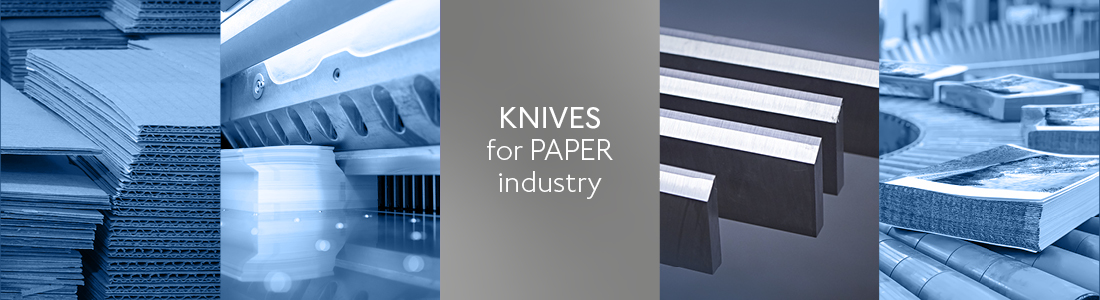
Evaluating the raw materials used in manufacturing high-performance Knives For Paper Industry operations is critical for matching blade capabilities with production demands. The metallurgical composition dictates the blade's wear resistance, toughness, and ability to hold a sharp edge under continuous industrial stress.
Standard tool steels like 52100 and D2 are highly prevalent in older or lower-speed converting operations. They are relatively easy to machine, straightforward to regrind in-house, and offer high toughness, meaning they can absorb impacts without shattering. D2, with its high chromium content, offers decent wear resistance for general-purpose slitting.
However, these alloys exhibit faster wear rates on abrasive papers containing recycled content or heavy fillers. They also have lower heat tolerance compared to advanced alloys, making them unsuitable for ultra-high-speed lines where friction-induced heat can draw the temper from the steel. These steels are best suited for short runs, older machinery with lower speeds, or facilities with frequent, accessible regrinding capabilities.
High-speed steels provide excellent wear resistance and maintain their hardness at much higher operating temperatures than standard tool steels. The addition of tungsten, molybdenum, and cobalt allows these blades to withstand the thermal stress of continuous high-speed paper converting without softening.
While the initial acquisition cost is higher than D2, the extended run-time between blade changes often justifies the investment. HSS blades require specialized aluminum oxide or CBN grinding wheels for sharpening to prevent burning the edge during the regrind process. They are the workhorse material for medium-to-high volume continuous runs on standard paper grades, offering a reliable balance of toughness and wear resistance.
Powdered Metallurgy (PM) steels bridge the performance gap between traditional High-Speed Steel and Tungsten Carbide. The PM manufacturing process creates an extremely uniform grain structure with evenly distributed carbide particles. This uniformity prevents the micro-chipping often seen in conventionally cast steels and maintains exceptional tip integrity over long runs.
Alloys like CPM 10V and 15V offer massive upgrades in wear resistance, making them excellent for abrasive recycled boards, kraft paper, and high-speed coated paper lines where durability is paramount. While they command premium pricing, their ability to hold a sharp edge through highly abrasive materials significantly reduces machine downtime for blade changes.
Tungsten Carbide offers the absolute maximum lifespan in paper slitting applications. It can run up to ten times longer than standard steel between changes, maintaining a pristine, razor-sharp cutting tip that produces zero dust and perfect edge quality. Carbide is essentially immune to the abrasive wear caused by paper fibers and clay coatings.
However, Carbide is highly brittle. It lacks the impact toughness of steel and is susceptible to catastrophic failure from operator mishandling, machine vibration, or minor installation errors. Dropping a carbide blade on a concrete floor or engaging the slitter with excessive pneumatic pressure will shatter the blade instantly. Carbide is strictly reserved for ultra-high-volume, 24/7 operations cutting clean, non-recycled paper where setup environments are rigidly controlled and machine bearings are in perfect condition.
Metallurgy | Wear Resistance | Toughness (Impact) | Best Use Case |
|---|---|---|---|
D2 Tool Steel | Moderate | High | Low-speed runs, frequent regrinding |
M2 / M42 HSS | High | Moderate | High-speed continuous standard paper |
PM Steels (10V) | Very High | Moderate | Abrasive recycled boards, kraft |
Tungsten Carbide | Extreme | Low (Brittle) | 24/7 clean paper runs, rigid machines |
The physical shape of the cutting edge significantly impacts performance, cut quality, and blade longevity. Engineers must specify the exact geometry required for their specific material to optimize the shearing action and minimize dust.
Single bevel configurations are the standard for most shear slitting applications. The flat side of the top blade runs flush against the bottom anvil, while the beveled side pushes the waste trim away from the cut. This ensures a clean, 90-degree edge on the finished roll. Double bevel configurations are primarily used in specific score slitting or center-cut applications where material displacement must be managed equally on both sides of the blade. The choice depends entirely on the slitting method and the desired material flow through the machine.
Bevel angles present a distinct mechanical trade-off. Acute angles (e.g., 30 degrees) offer exceptionally clean cuts with minimal resistance, making them ideal for delicate tissues or thin films. However, the thin edge wears faster and is highly susceptible to chipping. Obtuse angles (e.g., 45 to 60 degrees) offer massive durability and can power through heavy board or recycled kraft without chipping, but they require more cutting force and can slightly crush the paper edge. Selecting the optimal angle requires balancing the strict cut quality requirements with the expected blade life.
A freshly ground blade often features microscopic burrs or a fragile wire edge that will break off immediately upon machine engagement, instantly dulling the blade. Micro-honing the intersection of the bevels eliminates these microscopic burrs, improving initial cut quality and preventing early failure. Radius-honed edges intentionally blunt the extreme microscopic tip point of the blade by a few microns. This protects the apex from premature fracturing during initial machine engagement and extends the functional life of the blade significantly.
The surface finish of the blade face plays a major role in heat generation. Polished, mirror-finish edges reduce friction as the paper web slides past the blade, lowering operating temperatures and preventing fiber buildup. Aftermarket coatings like Titanium Nitride (TiN), Titanium Aluminum Nitride (TiAlN), or Teflon are frequently applied to reduce adhesive build-up when slitting pressure-sensitive labels, tapes, or coated packaging stocks. These surface treatments enhance performance, reduce maintenance intervals, and prevent the blade from gumming up during long runs.
Moving beyond the theoretical specifications to operational realities ensures the successful integration of new slitting technology on the plant floor. Upgrading blades without addressing the surrounding mechanical environment often leads to failure.
Upgrading to premium blades like Tungsten Carbide on older machines with worn bearings or excessive axial run-out is a guaranteed path to shattered tooling. Carbide requires absolute rigidity. If the knife holder wobbles or the bottom anvil shaft has run-out exceeding 0.002 inches, the lateral vibration will destroy the brittle carbide edge within minutes. Auditing and calibrating knife holders, rebuilding worn pneumatic cylinders, and replacing degraded bearings are mandatory steps before upgrading blade materials. Machine condition dictates blade selection just as much as the material being cut.
Frequent blade changes on high-speed slitter rewinders carry significant safety implications. Industrial slitting blades are heavy, razor-sharp, and difficult to maneuver in tight machine frames. Analyzing the ergonomics of the installation process is crucial for operator safety and tool longevity. Implementing quick-change knife holders, pneumatic locking mechanisms, and magnetic handling tools protects operators from severe lacerations. Furthermore, these handling systems prevent accidental blade-to-blade impact chipping during setup, which is a primary cause of premature blade failure before the machine even starts running.
Selecting the right slitting knife requires matching the metallurgy and edge geometry to the specific paper grade and machine capabilities. Conduct a thorough audit of the current slitting process to identify primary failure modes, whether that is excessive dust, rapid wear, or edge chipping. Consult with tooling engineers to match blade materials to the specific production speeds and substrates running on the floor. Implement strict handling, inspection, and calibration protocols to maximize the lifespan of premium blades and ensure continuous, high-quality production.
To optimize your slitting operations immediately, take the following actions:
Audit all knife holders for pneumatic leaks and lateral run-out to ensure rigid blade engagement.
Implement a strict microscopic inspection protocol for all incoming reground blades to verify proper micro-honing and burr removal.
Transition from standard D2 steel to PM steel alloys on lines processing abrasive recycled kraft or heavy coated boards.
Install magnetic blade handling tools at all slitter stations to eliminate manual handling damage and improve operator safety.
A: Shear slitting provides a cleaner, more precise cut with significantly less dust generation compared to crush slitting. It uses a scissor-like action that cleanly severs fibers rather than crushing them against an anvil, making it mandatory for high-quality printing and converting.
A: While Tungsten Carbide offers exceptional wear resistance, it is highly brittle. It easily chips or shatters due to machine vibration, improper handling, or cutting materials with hard impurities, making it unsuitable for older machines or abrasive recycled papers.
A: A more acute bevel angle provides a cleaner cut with less resistance but is fragile and wears faster. A more obtuse angle is highly durable and withstands impacts but requires more cutting force and may cause slight edge crushing on delicate materials.
A: Excessive paper dust is typically caused by dull blades, micro-chipped edges, incorrect bevel angles, improper blade overlap, or using the wrong slitting method for the specific paper grade being processed.
A: Premium materials like Carbide and PM steels require perfectly rigid setups. If a machine has worn bearings or excessive run-out, the resulting vibration and misalignment will cause these harder, more brittle blades to fracture immediately upon engagement.


